Strengthening Patient Registration to Reduce Unclaimed Identified Decedents: A Quality Improvement Initiative in Sri Lanka
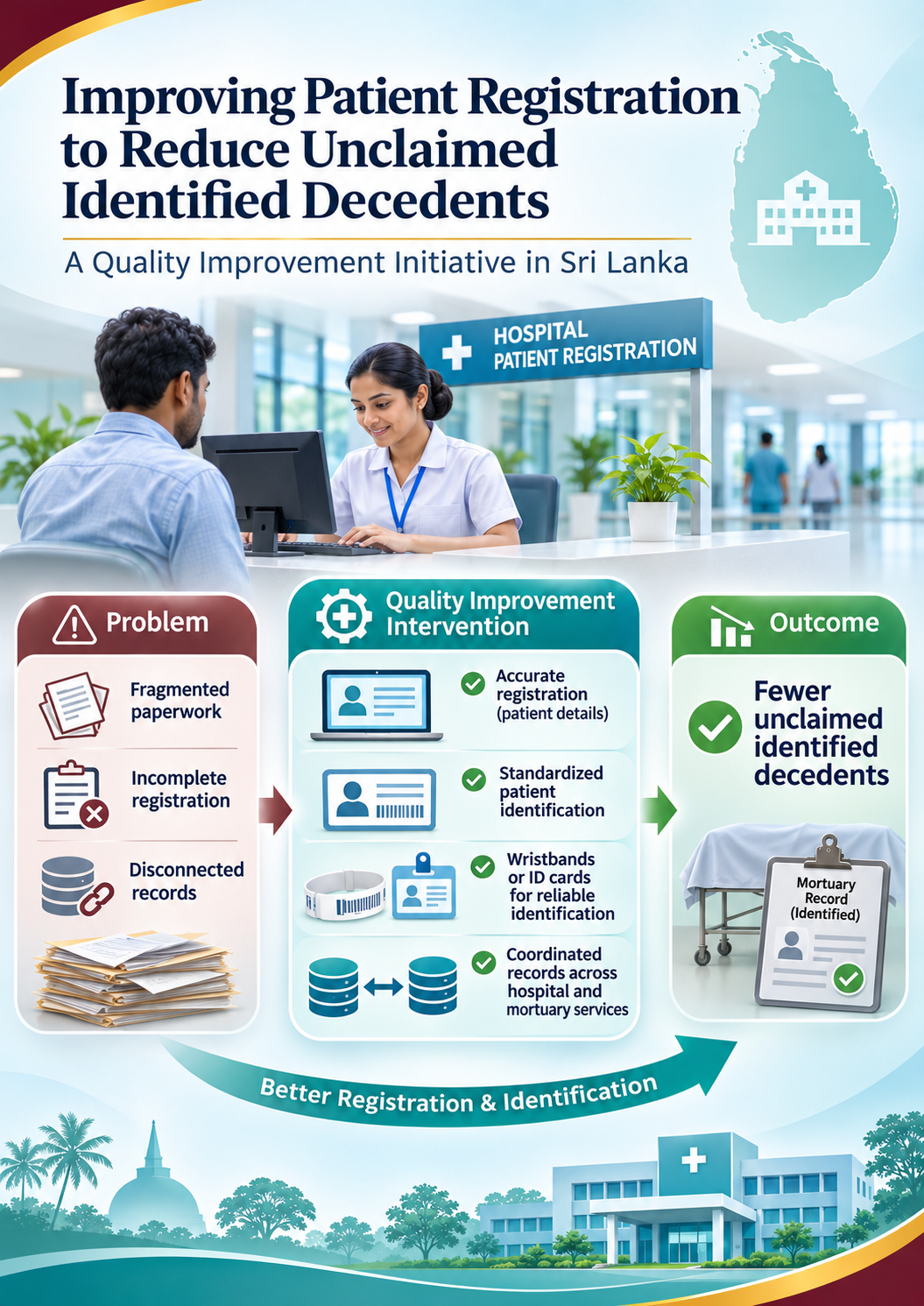

Strengthening Patient Registration to Reduce Unclaimed Identified Decedents: A Quality Improvement Initiative in Sri Lanka
Background: Identified but unclaimed decedents pose challenges for medico-legal services, mortuary management, and timely family notification. Incomplete or inaccurate patient registration information may contribute to difficulties in locating next of kin. This study describes a quality improvement initiative aimed at strengthening patient registration and examines changes in the proportion of identified but unclaimed decedents following its implementation.
Methods: A single-centre, uncontrolled before-and-after quality improvement audit was conducted at Base Hospital Puttalam, Sri Lanka. Following stakeholder consultation, medical record review, and root-cause analysis, a multicomponent intervention was implemented in September 2025. It included staff education, standardization of mandatory registration information, verification of patient and next-of-kin details, and regular monitoring with feedback. The proportions of identified but unclaimed decedents among medico-legal postmortem examinations were compared between two 12-month periods: 1 September 2024 to 31 August 2025 and 1 September 2025 to 31 August 2026. Differences were assessed using Fisher’s exact test.
Results: The proportion of identified but unclaimed decedents decreased from 3.44% (12/349) before the intervention to 0.56% (2/354) afterward (p = 0.0065; odds ratio = 6.25, pre-intervention versus post-intervention; exact 95% confidence interval: 1.38–57.95). The proportion of unidentified decedents decreased from 2.58% (9/349) to 1.69% (6/354), without a statistically significant difference (p = 0.4467).
Conclusion: A significant reduction in the proportion of identified but unclaimed decedents among medico-legal postmortem examinations was observed following implementation of the patient registration initiative. However, the uncontrolled study design, potential selection bias, and absence of systematic pre- and post-intervention measurements of registration completeness prevent causal attribution. Further evaluations incorporating direct process measures and appropriate comparison groups are warranted.