
Hybrid Cervical Trauma Following Close-Range Pyrotechnic Assault: Medico-Legal Reconstruction of Delayed Septic Death
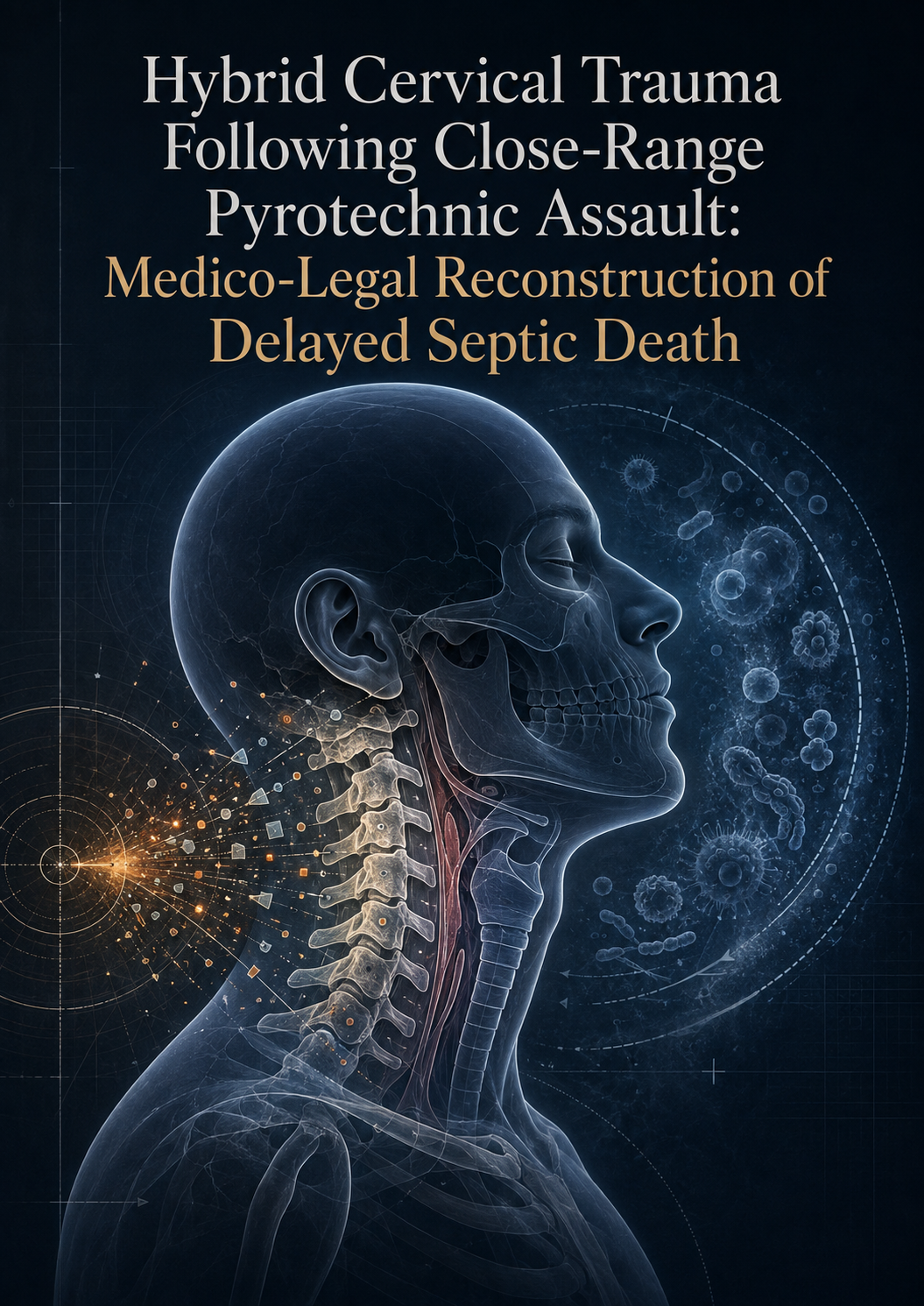

Background: Civilian pyrotechnic devices are primarily associated with accidental recreational injuries. However, when deliberately directed toward an individual at close range, they may produce complex traumatic patterns involving thermal injury, mechanical penetration, and potentially pressure-related effects, creating significant diagnostic and medico-legal challenges.
Case presentation: We report the case of a 29-year-old man who sustained deep cervical burns and a penetrating cervical wound following an alleged close-range assault with a handheld pyrotechnic device on January 17, 2026. According to the investigative information available to the forensic team, the device was thrown toward the victim’s cervical region but was not recovered or subjected to forensic examination. Initial contrast-enhanced computed tomography demonstrated a fracture of the left C7 transverse process, an extensive cervicomediastinal hematoma, and associated thoracic injuries, without definite vascular or tracheal disruption. Despite intensive care management, the patient developed progressive cervicothoracic infectious complications and bilateral pleuropulmonary involvement and died one month after the initial trauma.
Forensic autopsy demonstrated a liquefied infected cervical hematoma anatomically continuous with the external wound and an anterior tracheal perforation, together with bilateral suppurative pneumonia. The major cervical vessels and esophagus were intact, and no retained foreign body was identified. Death was attributed to septic shock secondary to infected cervicothoracic trauma associated with tracheal perforation and bilateral suppurative pneumonia.
The injury pattern was interpreted as a form of hybrid cervical trauma, defined in this report as the coexistence of confirmed thermal and penetrating mechanical injuries, with a possible but unconfirmed pressure-related component and subsequent infectious evolution within the same anatomical region. Because the device was not recovered and no specific blast markers or retained fragments were identified, the precise nature of the penetrating element and the contribution of pressure-related effects could not be established with certainty.
Conclusion: This case illustrates the potentially fatal consequences of intentional close-range pyrotechnic exposure and demonstrates that apparently limited cervical wounds may conceal severe internal injuries. It further highlights the importance of integrating investigative information, clinical evolution, serial imaging, microbiological findings, and forensic autopsy when reconstructing the causal pathway in delayed traumatic deaths.